 Story Circle
Interactive fiction and branching stories
Interactive fiction is a story whose shape depends on the reader. Instead of one fixed sequence of pages, the text offers points where the reader decides what happens next — and different decisions lead through different parts of the story, sometimes to different endings.
It is an old form with several names attached to it: text adventure, gamebook, choose your own adventure, hypertext fiction, visual novel, branching narrative. They differ in how the reader acts, not in the underlying idea. This page covers the forms, the structures writers build with them, and how Story Circle’s version — a chapter tree written by many authors — works.
A branching story is not one story with detours. It is a set of stories that share a beginning.
That is why branching is hard to write and easy to abandon: every choice you add multiplies what still has to be written.
The main kinds of interactive fiction
Parser games
You type what you want to do — open the door, take the lamp — and the program answers in prose. The oldest computer form of interactive fiction, and still the most demanding to write, because the story has to anticipate what a reader might type.
Choice-based stories
The text stops and offers a short list of options. Gamebooks did this with numbered paragraphs; apps do it with buttons. Much easier to write than a parser game, because the set of possible actions is exactly the set you wrote.
Hypertext fiction
Links inside the prose lead to other passages. The choice is not announced as a menu; the reader follows what interests them, and the same passage can be reached from several directions.
Visual novels
Long stretches of text with artwork and voices, interrupted by decision points. Closer to reading than to playing, with branching that often converges on a small number of endings.
A short history, in four moves
The mid-1970s: caves you typed into. Colossal Cave Adventure put a reader inside a described world and asked them to type what to do next. Zork followed, and through the late 1970s and 1980s parser games became a commercial genre.
1979: the branching paperback. The Choose Your Own Adventure series began publishing in 1979, and Fighting Fantasy followed in 1982. Both used the same mechanism — a numbered paragraph, two or three options, turn to the page you chose — and both put branching fiction in front of millions of children who had never seen a computer.
2009: writing branches without programming. Twine was released in 2009 and made a branching story something you could build by writing passages and linking them, rather than by writing code. A generation of short interactive fiction came out of it, and later tools followed the same idea.
Now: branching as a serial. The newer move is to stop treating a branching story as one finished artefact. If the tree is public and unfinished, other writers can extend it — and the reason branching was so hard, the amount of writing it multiplies, stops being one author’s problem.
The shapes a branching story can take
Writers who map these stories tend to see the same few shapes recurring. Knowing which one you are building is the difference between a tree you can finish and one you abandon.
The time cave
Every choice branches and nothing ever rejoins. Maximum freedom, and the reason most branching projects die: the writing doubles at every level, so depth costs exponentially.
The gauntlet
One main line with short side branches that either loop back or end quickly. Cheap to write, and it keeps a strong spine — but the reader can feel that most choices do not really change anything.
Branch and bottleneck
The story opens out, then narrows back to a shared chapter, then opens again. The workhorse shape: it gives real divergence without multiplying the ending count, because every branch has somewhere to come home to.
The open map
Places or scenes the reader can visit in any order, with the ending gated on what they found. Less a tree than a space — good for mystery, hard to keep coherent with many authors.
Three rules travel well across all four shapes. Put a choice where the character would genuinely hesitate, not on a schedule. Make the options differ in what the character wants, not in which door they open. And let a branch end — a short path with a real ending beats a long one that trails off.
The chapter tree
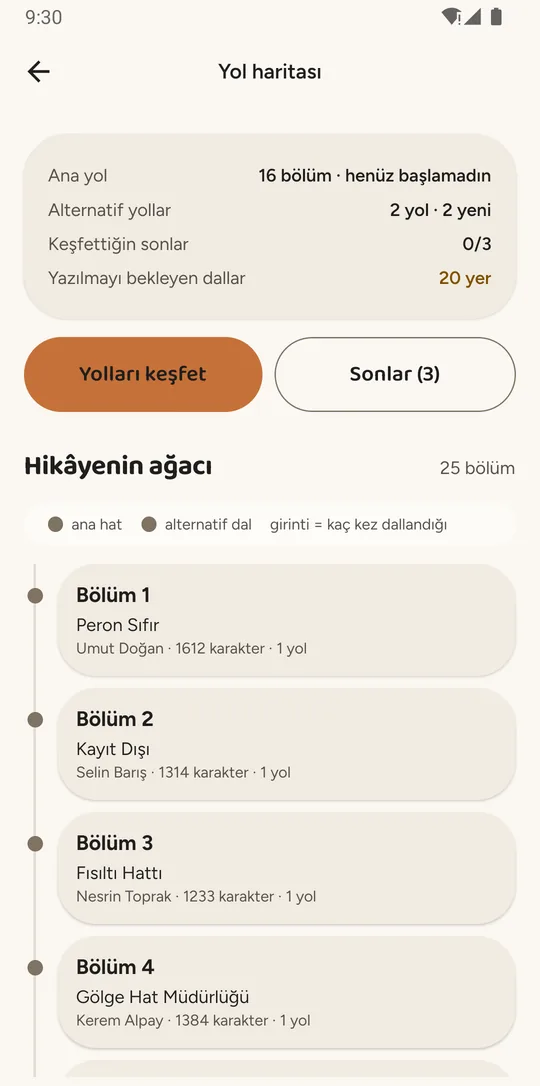
In Story Circle a book is a tree of chapters. A chapter is one node, written by one author. Once it is published, continuations attach beneath it — and in a branching book there can be more than one.
Branch limit. The person who creates the book sets how many continuations a single chapter may carry. That number is the whole difference between a readable tree and a time cave: it caps how fast the story can widen, so the book still converges on endings someone will actually reach.
Main path. One route through the tree is marked as the spine of the book. A reader who just wants the story follows it; a reader who wants to explore takes the alternative paths beside it.
Several endings. Different paths can finish in different places. The road map counts how many endings a book has and how many of them you have found.
Open branch slots. Every place where a continuation could be written but has not been yet is visible and claimable. Whoever locks one first writes it — there is no queue and no turn order.
What a reader does with all this
Reading a branching book is not a puzzle. You read a chapter, and where more than one continuation exists you pick the one you want. Your position is remembered per book, so you can leave in the middle of a path and come back to it.
Because paths are permanent, a second read is a genuinely different book rather than a re-read. The road map keeps track of which endings you have reached, which is the closest thing the app has to a score — and it is optional. You can read a branching book straight down the main path and never touch a branch.
Frequently asked
What is interactive fiction?
Interactive fiction is a story whose shape depends on the reader. Instead of one fixed sequence of pages, the text offers points where the reader decides what happens next, and different decisions lead through different parts of the story.
What is the difference between interactive fiction and a choose-your-own-adventure book?
A choose-your-own-adventure book is one form of interactive fiction: the reader picks from a short list of options and turns to a numbered page. Interactive fiction is the wider category, which also covers parser games where you type commands, hypertext stories, and visual novels.
How does a branching book work in Story Circle?
A published chapter can carry more than one continuation. The number is capped by the branch limit the book owner set when they created the book. The reader picks which continuation to follow, so one book can have several distinct endings.
Does a branching book still have a main story?
Yes. Story Circle marks a main path through the tree and shows alternative paths beside it, so a reader can either follow the spine of the book or go exploring.
Can I write a branching story without programming?
In Story Circle you never write code. You pick a published chapter that still has an open branch slot, lock it, and write the continuation as plain prose. The branch structure is the chapter tree itself.
Related pages
Collaborative writing
Round-robin, voting, open editing, branching — where each model stalls, and what replaces it.
Glossary
Chapter, lock, branch, revision, coin — the words the app uses, defined.
How to write a story
Craft that applies whether your story branches or runs straight.
What is Story Circle?
A community-written book app for Android. Free, no ads, launching soon.