 Story Circle
How to write a story
A story is a person who wants something, and something standing in the way. Everything else — plot, world, style, theme — is built on that pair. If you are stuck before you have started, write one sentence that names both, and you have something to write.
What follows is craft, not inspiration: how to find the want and the obstacle, how to build a scene, how to open, how to write dialogue that carries weight, how to end a chapter so the next one gets read, and what to do on the days nothing comes. None of it requires an app, a course or a notebook you have not bought yet.
A scene where a character wants nothing is not a slow scene. It is not a scene.
This is the single most useful diagnostic in drafting: when a passage feels dead, ask what the character in it is trying to get, and from whom.
Want and obstacle
Characters are not made interesting by their traits. They are made interesting by their wants — and specifically by wanting something they cannot simply be given.
A want needs three properties to be usable. It has to be concrete enough that the reader can tell whether it has been achieved: not she wanted to be happy, but she wanted her brother to answer the phone. It has to be active: something the character can pursue rather than wait for. And it has to be obstructed by something that will not move on its own.
The best obstacles are not walls. They are other people who want something incompatible — because a wall can only be climbed once, while a person can escalate. A locked office door is a problem. A colleague who has decided you should not go in there is a story.
Two questions will carry a whole draft. What does this character want in this scene? and what will it cost them to get it? If the answer to the second is “nothing”, you have found the scene you should cut.
Write in scenes, not in summary
A scene is a stretch of story with a place, a continuous stretch of time, and one change. Something is different at the end of it from how it was at the start: a decision made, a fact learned, a relationship moved, a door closed.
Summary is what happens when you write about events instead of inside them. They argued for an hour and she left angry is summary. The scene version has the two of them in a specific kitchen, with a specific thing one of them says that cannot be taken back. Summary has its uses — it moves you across weeks in a sentence — but it cannot carry the moments the story is actually about.
Build a scene in four moves:
- Land somewhere. One or two concrete details of place, early. Not a description — an anchor.
- Start the want. Within a few lines, the reader should know what the character is here to get.
- Push back. The thing in the way does what it does. The character adapts, tries again, or escalates.
- Change something. End on the difference, then stop. Do not stay to explain.
Enter scenes late and leave them early. Almost every first draft starts its scenes a paragraph or two before anything happens; cut those paragraphs and the scene almost always improves.
The first line, and the first page
A first line has one job: make the second line necessary. It can do that in three ways.
- A fact that raises a question. State something plainly true in this world that the reader cannot yet explain.
- A voice worth following. Someone speaking with enough personality that the reader wants more of them, regardless of subject.
- A moment already moving. Begin inside an action, and let the reader assemble the context as they go.
Examples, written for this page rather than borrowed from anywhere: The station had been closed for twelve years, and someone was still paying the electricity bill. (a fact that raises a question). I have never been good at funerals, which is unfortunate, given the family. (a voice). The second time the door opened, she did not turn around. (already moving).
What a first line should not do is set the weather, describe a character in a mirror, or explain the world before anyone has a reason to care about it. Background is a debt the reader pays before they have received anything — postpone it. You can almost always delete the first paragraph of a first draft and lose nothing.
Dialogue
Dialogue is not conversation. Real conversation is mostly maintenance — greetings, confirmations, filler. Dialogue keeps only the parts under pressure.
- Cut the arrival and the departure. Start at the first line that matters and end at the last one. Nobody needs to say hello.
- Let people want different things. Two characters who agree produce no dialogue, only exposition split across two mouths.
- Let them not answer. A character who replies to a question with a different question, or with an action, tells you more than one who answers.
- Give each a different rhythm. One speaks in long qualified sentences, another in four words. You will need far fewer attributions.
- Use “said”. It disappears. Replacing it with expostulated or hissed draws attention to the writer, not the speaker — and an adverb after it usually means the line itself is not doing its job.
- Break it with action. A gesture between lines sets pace and shows who is uncomfortable, without a single word about feelings.
The test: cover the attributions and read the lines. If you cannot tell who is speaking, the characters do not yet talk differently enough.
How to end a chapter
A chapter ending is a decision about whether the reader continues. Most drafts end chapters on a summary — a paragraph explaining what just happened and how the character feels about it — which is the one ending guaranteed not to pull anyone forward.
Endings that work tend to be one of these:
- A change. Something is now true that was not true at the start. End on the sentence that makes it true.
- A decision. The character chooses, and you stop before the consequences.
- A new question. Information arrives that reframes what came before.
- A door opening. Someone or something enters, and you end on the entrance.
Cheap versions of these exist — a fake threat resolved in the first line of the next chapter teaches readers not to trust your endings. Once is a hook; three times is a habit they will recognise.
This matters more in serialised and collaborative writing than anywhere else. In a book where the next chapter is written by somebody else, your ending is the brief you hand them. End on a change and you have given them something to write; end on a summary and you have given them a blank page.
Writer’s block, taken apart
“Writer’s block” describes a symptom with several unrelated causes, which is why general advice about it rarely helps. Find the cause first.
You do not know what happens next
This is not a writing problem, it is a plot problem, and you cannot solve it by staring at prose. Stop drafting and list five things that could happen next — including two you would never use. The obvious one usually stops looking obvious by number four.
You are bored by the scene
If you do not want to write it, nobody wants to read it. Either cut it and summarise the outcome in a line, or find what the character wants in it that you had not noticed. Boring scenes are almost always scenes with no want in them.
You are editing while drafting
Rewriting the same paragraph six times is not slow progress, it is a different activity. Give yourself permission to write it badly, mark the spot, and move on. Drafting and revising use different attention and fight each other.
The task is too large to start
“Write a novel” is not something you can begin this evening. “Write the scene where he finds the letter” is. Shrink the unit until it fits inside one sitting.
Two mechanical tricks that work regardless of cause. Write out of order — the scene you are looking forward to is allowed to be written today. And stop mid-sentence at the end of a session: starting tomorrow is much easier when the first thing you have to do is finish a sentence you already know the end of.
Where story ideas come from
Ideas are not found, they are constructed — usually by putting pressure on something ordinary until it stops being ordinary. Five reliable methods:
- Change one rule. Take the world as it is and alter a single fact, then follow the consequences honestly. One change with consequences beats ten changes without.
- Collide two unrelated things. A job you know nothing about and a fear you know everything about. Most of the energy in a premise comes from the join.
- Ask what would have to be true. Start from an image you cannot explain — a lit window in a building that was demolished — and work backwards to the world in which it makes sense.
- Take a small unfairness seriously. The petty injustices of ordinary life scale up into plots better than grand ones, because you already know exactly how they feel.
- Give someone an impossible obligation. A promise they cannot keep and cannot break is a whole book, pre-loaded.
A caution: a premise is not a story. A city under the desert is a setting. It becomes a story when someone in it wants something they are not allowed to have.
Revising without destroying it
Leave the draft alone for a few days first. You cannot see your own sentences while you can still remember choosing them.
- Read it aloud. The single highest-yield revision technique there is. Your mouth finds the clumsy sentences your eye slides over.
- Check every scene for its change. If you cannot name what is different at the end, the scene is a candidate for merging or cutting.
- Delete the explaining. Look for the paragraph after a good moment where you tell the reader what the moment meant. It is nearly always deletable, and the moment gets stronger.
- Cut adverbs where the verb can do it. Walked quickly is weaker than a verb that already means that.
- Fix the first page last. You now know what the story is about, which you did not when you wrote it.
The fastest way to get better is to finish things
Craft advice only becomes skill through completed drafts, and the reason most people do not finish is scale. A novel asks for a year before it gives you anything back. A chapter asks for an evening.
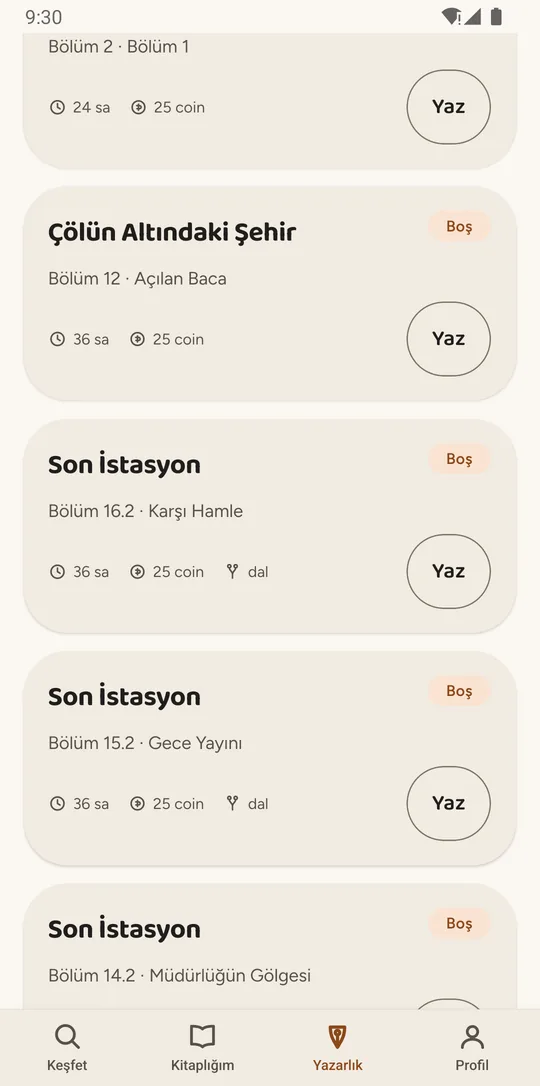
That is the case Story Circle is built around. A book is written by a community: each chapter is written by a different author, and any chapter still open can be taken by whoever starts writing it first — no queue, no turn order, no waiting to be picked. You inherit a story that is already moving, with characters someone else has already made you care about, and you write one chapter of it.
What you write stays yours: you keep the copyright and grant the platform only a non-exclusive licence to publish it. Every submitted chapter passes an automatic content review before it goes live, and then publishes on its own — nobody has to approve it.
How the writing cycle works · More on writing with other people
Frequently asked
How do I start writing a story?
Write one sentence naming a person, what they want, and what is in the way. Then write the first scene in which they try to get it and fail. You do not need the ending, the title or the world; you need one person trying something.
What is the hardest part of a first draft?
Usually the middle, because the opening was fuelled by the idea and the ending is not close enough to pull. The reliable fix is to stop writing sentences and write the next event instead: what happens, in one line, then dramatise it.
How do I get over writer’s block?
Treat it as a symptom, not a condition. Most blocks are one of three things: you do not know what happens next, you are trying to write a scene you do not care about, or you are editing while drafting. Each has a different fix — outline the next event, skip to the scene you actually want, or lower the quality bar on purpose.
How long should a chapter be?
Long enough to contain one change and short enough to read in one sitting. In practice most serialised chapters land somewhere between a thousand and three thousand words, and the ones that get read to the end are the ones that finish on a change rather than a summary.
Where can I practise writing with other people?
Story Circle is a mobile app where a book is written by a community: you can take one open chapter of someone else’s book, write it, and see it published once it passes an automatic content review. One chapter is a much smaller commitment than a novel, and it comes with a story already in motion.
Related pages
Collaborative writing
How groups divide a book between them, and why most attempts stall.
Interactive fiction
Branching stories: the shapes they take and how to keep one finishable.
Glossary
Chapter, lock, branch, revision — the words the app uses.
What is Story Circle?
A community-written book app for Android. Free, and without ads.